
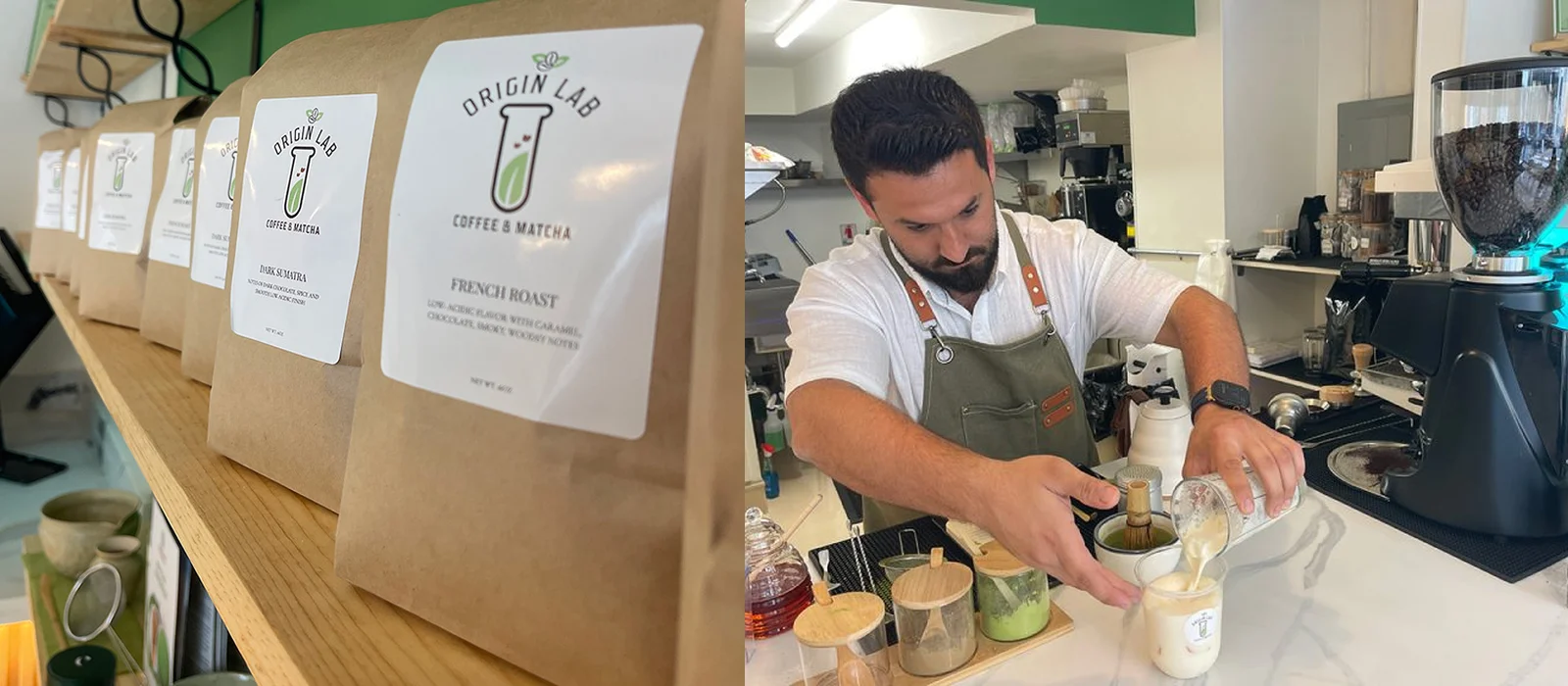
Origin Lab · specimen no. 211
For specialty coffee near Union Square, Origin Lab Coffee & Matcha at 211 Sutter St serves espresso drinks, pour over, cold brew and our signature espresso clouds from 6 AM every day. Our coffee is locally roasted in a Southern Italian style, a medium-dark roast with notes of dark chocolate, hazelnut and caramel. Start with a cortado ($6.00) to taste the espresso, or an Amber Velvet Cloud ($7.95) for something new.
San Francisco has a fair claim to the phrase "specialty coffee." Erna Knutsen, who worked in the city's coffee trade, coined it in 1974, long before the city filled up with pour-over bars and cafes that print tasting notes on their bags. So when people search for specialty coffee in San Francisco, they are asking a question this city has been answering for half a century.
This guide covers what the term really means, the San Francisco story behind it, how our own coffee is roasted and brewed, and how to order the right drink for your taste, from a plain espresso to an espresso cloud.
What Makes Coffee "Specialty"?
"Specialty" is not a marketing word when the professionals use it. The specialty coffee standard, set by the Specialty Coffee Association (SCA), comes down to three tests:
80+
Points when cupped
Trained tasters score the coffee on a 100-point scale. Only coffee that reaches 80 counts as specialty.
0 to 5
Defects per 350 g
A sample of milled green beans may have no more than five defects, such as broken, sour or insect-damaged beans.
Ripe
Cherries picked by hand
Selective picking means only mature coffee cherries are harvested, by hand.
Within specialty, the score sets the tier:
Below 80 Not specialty80 to 84.99 Very good85 to 89.99 Excellent90 to 100 Outstanding
In the cup, the difference shows up as clarity. Commercial coffee is blended to taste the same every time at a low price. Specialty coffee is chosen for flavor first, so you can taste chocolate, fruit, nuts or caramel in it rather than just "coffee."
San Francisco Named It: A Short History of Coffee in the City
Few cities have shaped American coffee as much as this one. A few of the moments that matter:
1850
Folgers begins
During the Gold Rush, the Pioneer Steam Coffee and Spice Mills opened in San Francisco. A young J.A. Folger became a partner, and the company later took his name (Folgers).
1900
Coffee in a vacuum can
San Francisco's Hills Bros. became the first company to pack roasted coffee in vacuum-sealed cans, keeping it fresh for months.
1956
Espresso arrives
Caffè Trieste opened at 601 Vallejo Street in North Beach, the first espresso house on the West Coast.
1966
The dark-roast era
Across the bay in Berkeley, Peet's Coffee & Tea started what is now called coffee's second wave, with darker roasts and espresso drinks.
1974
"Specialty coffee" is coined
Erna Knutsen, who worked at the San Francisco coffee importer B.C. Ireland, used the term in the Tea & Coffee Trade Journal for the best beans from special microclimates (Ms. Magazine). Her own company, Knutsen Coffees, was based in the city.
2003
The "third wave"
Coffee professional Trish Rothgeb popularized the phrase "third wave" for coffee sourced from farms, roasted lighter and brewed with care (Third-wave coffee).
The three waves, in plain English
| Wave | What it focused on | Typical cup |
|---|---|---|
| First | Low price and the same taste every time | Canned grocery coffee, instant coffee |
| Second | Where coffee comes from, dark roasts, espresso drinks | Lattes and cappuccinos at a cafe chain |
| Third | The farm, lighter roasts, careful brewing | Pour over with tasting notes on the bag |
Our Coffee: Locally Roasted, Southern Italian Style
Plenty of San Francisco cafes follow the third-wave habit of very light roasts, which can taste bright and tea-like. We go a different way. Our coffee is roasted locally in a Southern Italian style: a medium-dark roast with notes of dark chocolate, hazelnut and caramel.
That choice has deep roots. In Italy, the south has long preferred darker roasts for espresso, while roasts get a little lighter further north (Espresso). A medium-dark espresso tastes rich on its own and stays bold when you add milk or put a cream cloud on top, which is why it suits a menu built around lattes and espresso clouds.
Our house espresso sits at medium-dark: deep enough for chocolate and caramel, short of the smoky, bitter edge of a very dark roast.
Want it at home? Our Neapolitan Espresso Beans are $20.99 a bag, roasted locally, and we grind them for free for your brewer if you ask at the counter.
How to Taste Coffee Like a Cupper
The professionals who score specialty coffee taste it in a routine called cupping. You do not need a lab to borrow the idea. Try this with your next espresso or pour over:
1Smell first
Before you sip, breathe in over the cup. Much of what we call flavor is really aroma, and it is strongest in the first minute.
2Slurp
Take a small sip with a little air, the way cuppers do. It spreads the coffee across your whole tongue.
3Feel the body
Notice the weight in your mouth. A medium-dark espresso feels round and heavy; a light pour over feels thinner, closer to tea.
4Wait for the finish
Swallow and pause. Good coffee leaves a pleasant aftertaste, like cocoa or toasted nuts, not a harsh bitterness.
Then look for the notes. With our espresso, try to find the dark chocolate first, then hazelnut, then a caramel sweetness as it cools. Tasting the same coffee as an espresso and as a cortado is a good lesson too: milk softens the bitterness and brings the caramel forward.
Espresso, by the Numbers
Every espresso drink on our menu starts with the same short, strong shot. Here is what goes into one, using the Italian standard for espresso:
25 to 30 ml
in the cup, about 1 fl oz
9 bar
of water pressure
25 to 30 sec
to pull the shot
~65 mg
caffeine in one shot
The pressure pushes hot water through finely ground coffee and creates crema, the golden-brown foam on top of a good shot. Per sip, espresso is the strongest coffee you can order. Per drink, it is not: a single shot has about 65 mg of caffeine, while an 8-ounce cup of drip coffee has about 95 mg.
The Espresso Menu, Decoded
Most of the classic drinks are the same espresso with different amounts of milk, foam or water. The bars show the typical balance of each drink, so you can see why a cortado tastes stronger than a latte.
EspressoSteamed milkFoamHot water
Espresso$5.00
The shot on its own: the clearest way to taste the roast.
Macchiato$5.00
Espresso "marked" with a dash of frothy milk.
Americano$5.00
Espresso stretched with hot water: the size of drip coffee, the flavor of espresso.
Cortado$6.00
Equal parts espresso and warm milk. Small, smooth and still coffee-forward.
Flat White$7.00
More milk than a cortado, finished with thin, velvety microfoam.
Cappuccino$7.00
Espresso, steamed milk and a thick cap of foam.
Latte$7.00
The mildest: mostly milk, with a light layer of foam.
Mocha ($7.00) is a latte with rich chocolate. Proportions vary a little by cup size, but the order stays the same: the less milk, the more you taste the coffee.
Brewed Coffee: Drip, Pour Over, Cold Brew and the Black Eye
| Coffee | How it is made | What it tastes like |
|---|---|---|
| Drip Coffee $5.50 |
Hot water drips through ground coffee in batches | Classic, balanced, ready fast |
| Pour Over $6.00 |
Brewed to order by hand, one cup at a time | Cleaner and more detailed; worth a few extra minutes |
| Cold Brew $5.50 |
Steeped slowly in cold water | Smooth and low in bitterness, served cold |
| Black Eye $6.50 |
Brewed coffee with a double shot of espresso | The strongest cup on the menu |
| Café au Lait $6.00 |
Brewed coffee with steamed milk | Soft and mellow |
| Decaf Coffee $5.50 |
Freshly brewed decaffeinated coffee | All the flavor, for late afternoons |
If you are in a hurry before work, drip and cold brew are the fastest. If you have ten minutes, the pour over shows the coffee at its most detailed. Our guide to hot drinks in San Francisco has more ideas for cold, foggy mornings.
Espresso Clouds: Our Signature Twist
An espresso cloud is an iced drink crowned with a thick layer of espresso cream. You get the bold coffee on top and a smooth, sweeter base underneath, and the two mix as you drink. It is the coffee version of the clouds on our matcha drinks, which we explain in What Is a Matcha Cloud?
Creamy clouds
A whole milk or coconut milk latte under the espresso cream
Amber Velvet Cloud$7.95
Caramel latte, espresso cream, a light biscuit touch
Midnight Mocha Cloud$7.95
Dark chocolate latte with an espresso cream top
Banana Cream Cloud$7.95
Banana-blend latte, smooth and naturally sweet
Coco Snow Cloud$7.95
Coconut milk latte with biscuit and coconut flakes
Bright clouds
No milk in the base: lighter and more refreshing
Solar Ember Cloud$7.75
Orange juice under espresso cream, with orange zest
Tropic Luxe Cloud$7.75
Coconut water with toasted coconut flakes
Zest Fizz Cloud$7.75
Sparkling lime soda with fresh lime peel
Black Eye Cloud$7.50
Brewed coffee topped with espresso cream
The bright clouds surprise people the most. Espresso with orange juice sounds odd until you try it: the citrus lifts the coffee's chocolate notes, a little like an orange in a dark chocolate bar. For the fall, the cloud family also has a spiced version, the Pumpkin Nimbus Latte.
What Should You Order? Match It to Your Taste
Make It Yours
- Plant milk: oat, almond, soy or coconut, +$0.75.
- Extra shot: add a shot of espresso to any drink, +$1.50.
- Sweetness: our coffee drinks come unsweetened. Add agave, caramel or vanilla for $0.75.
- Iced: every espresso cloud is served iced. For a classic espresso drink over ice, ask the barista.
If the names on our menu are new to you, our Origin Lab menu guide explains what Cloud, Nimbus and Lab mean.
Where to Find Us Near Union Square
We are on the corner of Sutter and Kearny, about 6 minutes on foot from the Union Square plaza and 4 minutes from the Kearny Street exit of Montgomery Street station. Our guide to coffee near Union Square has walking times from the main landmarks.
Weekday mornings from 7 to 11 AM are our busiest time, so order ahead online and skip the line. We open at 6 AM every day, as our guide to the coffee shop that opens at 6 AM explains, and we are open on holidays too.
Taste it at the bar
Origin Lab Coffee & Matcha
211 Sutter St (corner of Kearny), San Francisco, CA 94108
Sun to Thu 6 AM to 8 PM · Fri and Sat 6 AM to 9 PM · open on holidays
Frequently Asked Questions
What is specialty coffee?
Specialty coffee is the highest grade of coffee. By the Specialty Coffee Association's standard, it scores 80 points or more out of 100 when professionally cupped, has no more than 5 defects in a 350 g sample and comes from ripe, carefully picked cherries.
Where did the term "specialty coffee" come from?
From San Francisco. Erna Knutsen, who worked at the San Francisco coffee importer B.C. Ireland and later founded Knutsen Coffees, used the term in a 1974 issue of the Tea & Coffee Trade Journal to describe the best-tasting beans from special microclimates.
Is San Francisco known for coffee?
Yes. Folgers and Hills Bros. both started here, Caffè Trieste in North Beach opened the West Coast's first espresso house in 1956, and the term "specialty coffee" was coined in 1974 by Erna Knutsen, who worked in the San Francisco coffee trade.
What is the difference between specialty coffee and regular coffee?
Regular commercial coffee is graded mainly on price and consistency. Specialty coffee must pass a professional tasting score of 80 or higher, with very few defects, so it tastes cleaner and shows more of its own flavor.
What roast does Origin Lab use?
Our coffee is locally roasted in a Southern Italian style: a medium-dark roast with notes of dark chocolate, hazelnut and caramel.
What is an espresso cloud?
An iced drink with a thick layer of espresso cream on top, our signature at Origin Lab. The base can be a flavored milk latte, like the Amber Velvet Cloud, or something lighter, like orange juice in the Solar Ember Cloud.
What is the difference between a cortado and a flat white?
A cortado is equal parts espresso and warm steamed milk, served small, so the coffee leads. A flat white has more milk, finished with a thin layer of velvety microfoam. At Origin Lab the cortado is $6.00 and the flat white is $7.00.
How much caffeine is in a shot of espresso?
About 65 mg in a single 30 ml shot, compared with about 95 mg in an 8-ounce cup of drip coffee. Espresso is stronger per sip, but a single shot has less caffeine than a full cup.
Can I buy Origin Lab coffee beans?
Yes. Our Neapolitan Espresso Beans are $20.99 a bag, locally roasted, and we grind them for free if you ask.
Where can I get specialty coffee near Union Square?
Origin Lab Coffee & Matcha at 211 Sutter St, on the corner of Kearny, is about a 6-minute walk from the Union Square plaza and opens at 6 AM every day.
San Francisco named specialty coffee. Come taste our version at 211 Sutter St, from 6 AM every day.