
Quick answer
The best matcha in San Francisco is bright green, smooth and tastes of tea before sugar. Downtown, start at Origin Lab, 211 Sutter St, which The Infatuation names the pick for matcha purists. Drinks come unsweetened unless you ask.
Matcha downtown, from 6 AM
Origin Lab Coffee & Matcha
211 Sutter St (corner of Kearny), San Francisco, CA 94108
Sun to Thu 6 AM to 8 PM · Fri and Sat 6 AM to 9 PM · (415) 660-7969
What Makes the Best Matcha in San Francisco?
San Francisco has plenty of matcha cafes, and a latte now costs around $7 at most of them (The Infatuation). At that price, it pays to know what good matcha looks and tastes like. These are the five signs we look for, whether the cafe is ours or someone else's.
| Sign | What to look for | Red flag |
|---|---|---|
| Color | Vivid, bright green, even in a latte | Dull, olive or yellowish green |
| Aroma | Fresh, grassy, a little sweet | Flat, dusty or no smell at all |
| Taste | Smooth, savory, a gentle bitterness | Harsh and bitter, or only sugar |
| Texture | Silky, no gritty bits at the bottom | Clumps or a sandy layer of powder |
| Sweetness | Unsweetened by default, sweetened if you ask | Pre-sweetened with no way to change it |
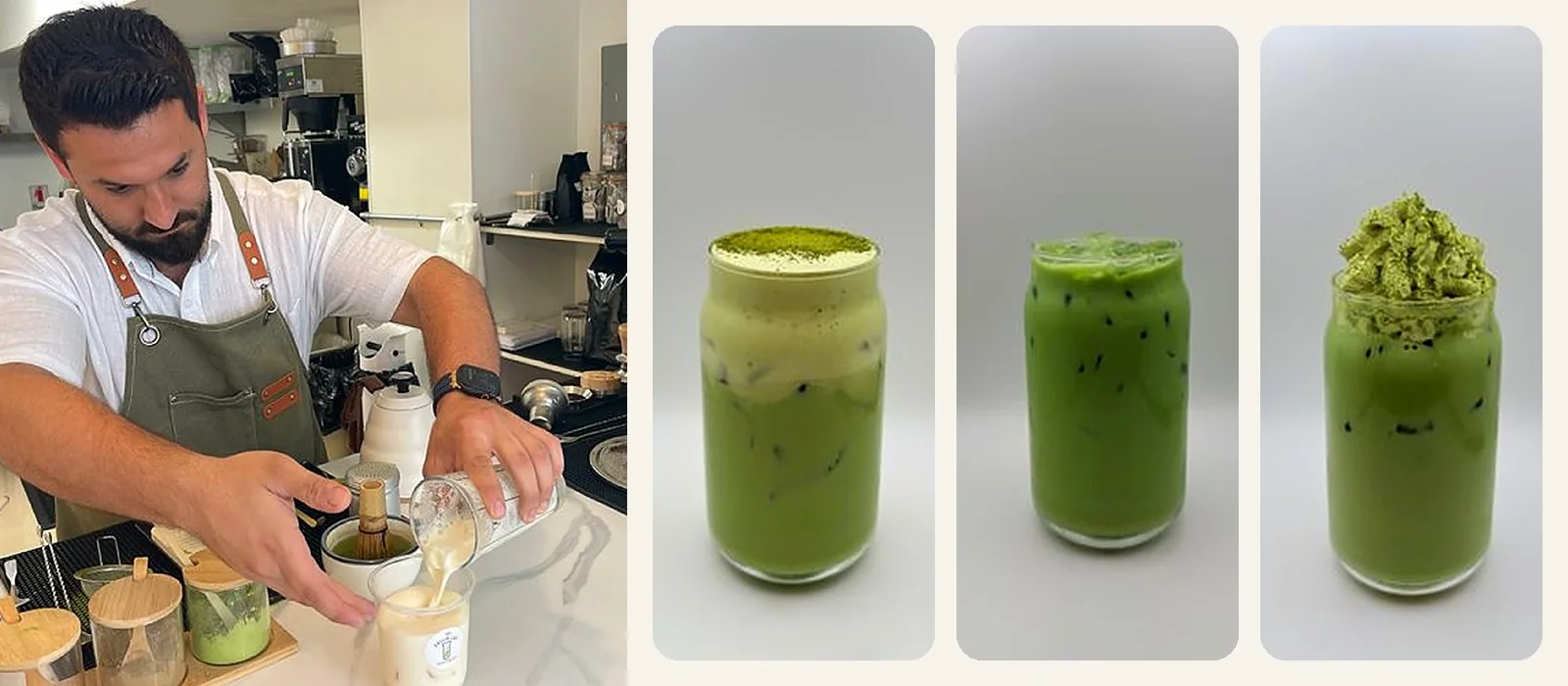
Color is the quickest clue. Tomoko Honda of the Kyoto tea house Ippodo told Food Network that good matcha has a vibrant green color, and that dull or yellowish green can mean lower-quality leaves or powder that has lost its freshness (Food Network). She also describes good matcha as having "a subtle bitterness alongside its depth", so a little bitterness is not a bad sign.
Does "Ceremonial Grade" Mean Better Matcha?
Not by itself. "Ceremonial" and "culinary" are not regulated in the United States and are not a standard grading system in Japan (Food Network). Any cafe can print "ceremonial grade" on a menu.
So treat the label as a starting point, not proof. The better questions are simple: Is the green bright? Does the tea taste smooth? Can you still taste it through the milk? A good cafe will be happy to make your first drink unsweetened so you can tell.
Matcha itself is green tea leaf, grown in the shade and ground into a fine powder, so you drink the whole leaf rather than an infusion (Matcha). That is why freshness and how the powder is stored make such a difference to the cup.
A 60-Second Test You Can Do at Any Matcha Cafe
You do not need to be a tea expert. Try this with your next drink:
| Step | What to do | What it tells you |
|---|---|---|
| 1. Look | Check the green before you stir. A clear cup helps. | Bright green means fresh, good leaves |
| 2. Swirl | Iced matcha settles. Swirl or stir once. | Gritty bits mean the powder was not mixed well |
| 3. Sip plain | Taste before adding anything sweet. | You taste the tea, not the syrup |
| 4. Wait | Notice the finish after you swallow. | Good matcha leaves a clean, savory taste |
Barista tip
Iced matcha separates as it sits, with the green settling under the milk. Give the cup a swirl before your first sip, or the first taste will be all milk and the last all matcha.
Why Matcha Costs More in 2026
If your matcha latte costs more than it did two years ago, the reason starts in Japan. Global demand has grown much faster than the supply of tencha, the shade-grown leaf that is ground into matcha.
| Figure | Number | Source |
|---|---|---|
| Japan's tencha output, 2024 | 5,336 tons, nearly 2.7 times ten years earlier | Reuters |
| Kyoto tencha auction, May 2025 | ¥8,235 per kg, up 170% on 2024 | Reuters |
| Japan's green tea exports, year to March 2026 | 13,125 tons, up 42%; value up 2.2 times | Jiji Press |
| Powdered tea share of those exports | About 70% | Jiji Press |
| Uji tencha market, 2026 season | 595 tons, the most since 1974 | Global Japanese Tea Association |
| Machine-picked tencha price, Uji 2026 | ¥17,250 per kg on average, a record | Global Japanese Tea Association |
Reuters reported that heat damage cut yields in the 2025 spring harvest, after Japan's hottest year on record (Reuters). Japanese growers have since moved more fields over to tencha, and the 2026 Uji market traded more tencha than in any year since it opened, at record prices (GJTEA).
For you, that means two things. Good matcha will keep costing more than coffee at many cafes, and a very cheap matcha drink can mean less matcha or a lower grade of powder. Paying for an extra serving of matcha is one way to get more flavor for your money.
Where to Get Great Matcha in Downtown SF
We are biased, so here is an outside view first. In its guide to the best matcha lattes in SF, updated in October 2026, The Infatuation lists 20 spots and writes: "For matcha purists who don't want distractions from the tea flavor, Origin Lab is your best match" (The Infatuation).
Origin Lab Coffee & Matcha is at 211 Sutter St, on the corner of Kearny, where Union Square meets the Financial District. Here is what you can expect:
- Ceremonial-grade matcha in ten drinks, from $6.50 to $8.25
- No sweetener unless you ask, with agave or vanilla on request
- Plant milks (almond, oat, soy, coconut) for $0.75 more
- Open from 6 AM every day, until 8 PM Sunday to Thursday and 9 PM Friday and Saturday
What to Order at Origin Lab
| If you want | Order at Origin Lab | Price |
|---|---|---|
| To taste the matcha itself | Pure Matcha Lab (iced, your choice of milk) | $7.75 |
| Something warm | Hot Matcha Latte | $6.50 |
| The signature drink | Velvet Matcha Cloud (matcha latte with matcha foam) | $7.95 |
| Matcha with fruit | Matcha Strawberry Nimbus | $7.95 |
| A lighter, citrusy cup | Yuzu Air Matcha Cloud | $8.25 |
The foam on our cloud drinks contains dairy and honey. For a vegan matcha, ask for plant milk and no cloud. To understand names like Cloud and Nimbus, read the Origin Lab menu explained. For walking times from hotels and BART, see our guide to matcha near Union Square.
Skip the line
Order your matcha ahead and pick it up at 211 Sutter St.
Matcha Beyond Downtown
If you have time to explore, two parts of the city are worth a trip for anyone who loves Japanese tea.
- Japanese Tea Garden, Golden Gate Park. Opened in 1894, it is the oldest public Japanese garden in the United States, and its tea house by the water serves matcha, hojicha and sencha (Japanese Tea Garden). Go for the setting as much as the tea.
- Japantown. One of the largest and oldest ethnic enclaves in the United States, centered on the Japan Center and its Peace Pagoda, a gift from the people of Osaka (Japantown). It is a good place to browse for matcha bowls, whisks and Japanese snacks.
From downtown, Japantown is a short ride west, and Golden Gate Park is farther west still.
Matcha Styles You Will Find in San Francisco
SF cafes have moved well beyond the plain latte. Here is what the common styles are, so you know what you are ordering:
| Style | What it is | Good for |
|---|---|---|
| Straight latte | Matcha and milk, hot or iced | Judging the tea itself |
| Foam-topped | A latte finished with a thick matcha or cream foam | A richer, creamier drink |
| Fruit matcha | Matcha layered with strawberry, mango or ube | First-timers who want something sweeter |
| Juice or sparkling | Matcha over orange juice, coconut water or sparkling water | A light, no-milk drink on a warm day |
| Hojicha | Roasted Japanese green tea, toasty and low in bitterness | People who find matcha too grassy |
| Matcha soft serve | Ice cream made with matcha | Dessert, or a second round |
If you are new to matcha, start with a straight latte, then try a foam-topped or fruit version. If you only drink coffee, our guide to coffee near Union Square covers the espresso side of the menu, and the coffee shop that opens at 6 AM guide has early-morning picks.
How We Put This Guide Together
Origin Lab is a matcha cafe, so we are not a neutral judge of other cafes, and we have not ranked anyone. Instead, this guide gives you the same checks we use behind the bar, backed by outside sources: Food Network's interview with Ippodo for quality, Reuters, Jiji Press and the Global Japanese Tea Association for supply and prices, and The Infatuation for an independent view of where to drink matcha in SF. Prices are from our menu in October 2026.
Frequently Asked Questions
Where is the best matcha in San Francisco?
It depends on how you like it. For tea-forward, unsweetened matcha downtown, The Infatuation lists Origin Lab at 211 Sutter St as the pick for purists. For matcha in a garden setting, the tea house at the Japanese Tea Garden serves it.
How can you tell if matcha is good quality?
Look at the color first: good matcha is a vivid green, while dull or yellowish green suggests lower-grade leaves or old powder. It should smell fresh, taste smooth with a gentle bitterness, and still taste like tea under the milk.
Is ceremonial grade matcha better?
Not always. "Ceremonial" and "culinary" are not regulated in the United States or standardized in Japan, so the label alone proves nothing. Judge the tea itself: color, aroma, smoothness, and whether the flavor holds up in a latte.
Why is matcha so expensive in 2026?
Demand has grown faster than supply. Japan's green tea exports rose 42% in the year to March 2026, and machine-picked tencha at the 2026 Uji market averaged a record ¥17,250 per kilogram. Cafes pay those prices for their matcha powder.
How much is a matcha latte in San Francisco?
Around $7 or more at most specialty cafes, according to The Infatuation. At Origin Lab, the Hot Matcha Latte is $6.50, iced matcha drinks are $7.75 to $8.25, plant milk adds $0.75 and an extra serving of matcha adds $2.00.
Should good matcha taste bitter?
A little. Good matcha balances grassy, sweet and slightly bitter notes, and a gentle bitterness is normal. If a drink tastes harsh and flat, or only tastes of syrup, the matcha is probably low grade or there is too little of it.
Is unsweetened matcha better?
It is the best way to judge the tea. Sugar hides weak matcha, so trying it unsweetened shows you the real flavor. At Origin Lab every drink comes unsweetened, and you can ask for agave or vanilla after your first sip.
Where can I get matcha near Union Square?
Origin Lab Coffee & Matcha is at 211 Sutter St, about a 6-minute walk from Union Square and 4 minutes from Montgomery BART. It serves ten matcha drinks, from the Hot Matcha Latte at $6.50 to the Yuzu Air at $8.25.
What matcha drink should I try first?
Start simple so you can taste the tea: a plain matcha latte, hot or iced. At Origin Lab that is the Hot Matcha Latte or Pure Matcha Lab. If you like it, try a foam-topped drink like the Velvet Matcha Cloud.
Can I get matcha early in the morning in San Francisco?
Yes. Origin Lab opens at 6 AM every day at 211 Sutter St, so you can get a matcha latte before work or before a flight. It stays open until 8 PM Sunday to Thursday and 9 PM Friday and Saturday.
The best matcha in San Francisco is the one that still tastes like tea under the milk. Come test ours at 211 Sutter St.